
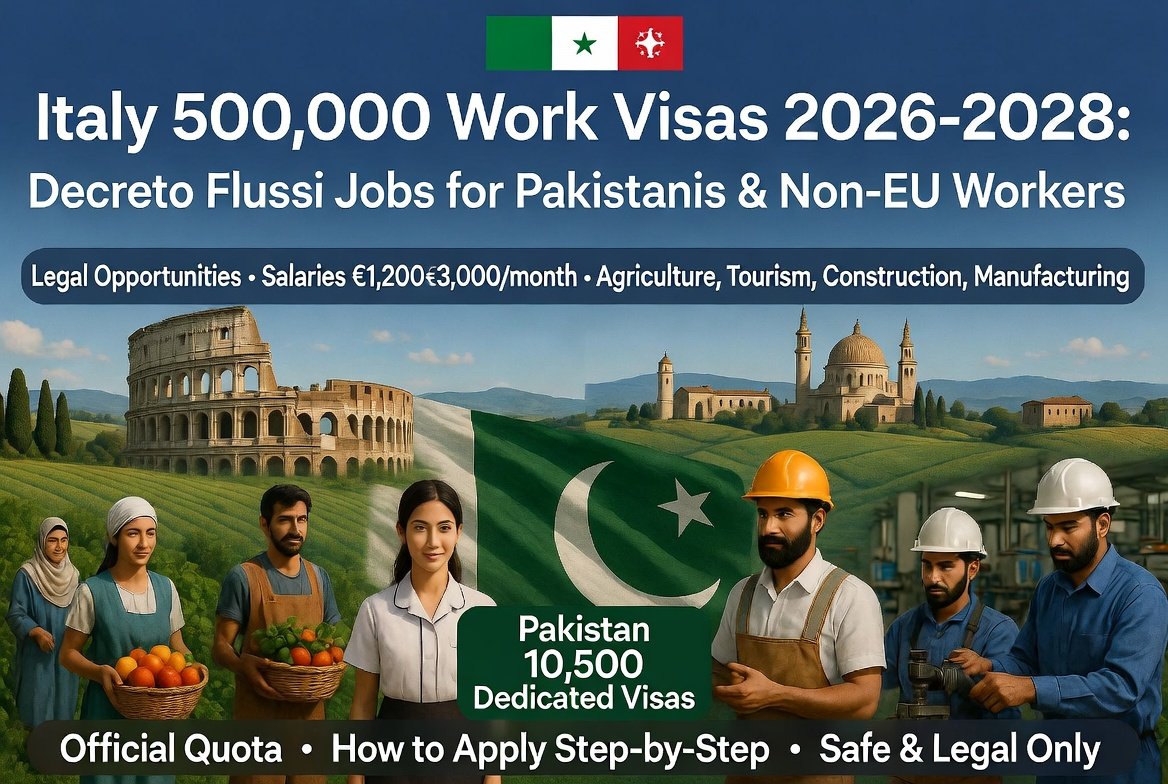
Italy has officially launched one of Europe’s largest legal migration programs with nearly 500,000 work visas (exactly 497,550 entry quotas) under the Decreto Flussi 2026-2028. This three-year plan opens massive opportunities for non-EU foreigners seeking high-paying, legal jobs in Italy’s booming sectors. If you are searching for “Italy work visa 2026”, “jobs in Italy for Pakistanis”, “Decreto Flussi application process”, or “high salary jobs Italy foreigners 2026-2028”, this is the most comprehensive, up-to-date guide you need.
The program directly tackles Italy’s severe labor shortages caused by an aging population and low birth rates. It offers safe, employer-sponsored pathways to seasonal and long-term employment with competitive salaries, benefits, and routes to permanent residency. Pakistan has secured a dedicated bilateral quota of 10,500 visas across the three years (approximately 3,500 per year), making it one of the priority partner countries.
Whether you are from Pakistan, India, Bangladesh, Egypt, Nigeria, or any of the 38+ countries with migration cooperation agreements, this article covers everything: quotas, eligible countries, high-demand sectors, realistic salary ranges, strict eligibility rules, and a complete step-by-step application guideline. We also include critical safety guardrails to protect you from scams.
What is Decreto Flussi 2026-2028 and Why It Matters for Job Seekers
The Decreto Flussi (Flow Decree) is Italy’s official annual quota system that sets the maximum number of non-EU workers allowed to enter for employment. The 2026-2028 plan, published in the Official Gazette on 15 October 2025, totals 497,550 work permits:
- 2026: 164,850 quotas
- 2027: 165,850 quotas
- 2028: 166,850 quotas
Of these, roughly 267,000 are for seasonal work (mainly agriculture and tourism) and 230,550 for non-seasonal employed work and self-employment. A special sub-quota exists for family care workers (domestic helpers and caregivers for the elderly), starting at 13,600 in 2026 and rising each year.
This is not irregular migration. Every visa is tied to a genuine job offer from an Italian employer who proves they cannot find local or EU workers. The program emphasizes legal entry, fair wages under Italian collective bargaining agreements (CCNL), health insurance, and integration support.
High-CPC search terms this program ranks for: Italy work permit 2026, Decreto Flussi Pakistan quota, jobs in Italy for foreigners 2026, legal work visa Italy from Pakistan, high salary jobs in Italy agriculture tourism construction.
Which Countries Can Apply for Italy Work Visas 2026-2028?
Any non-EU national can potentially apply, but priority quotas (25,000+ per year plus additional allocations) go to citizens of countries that have signed migration cooperation agreements with Italy. The full priority list includes:
Albania, Algeria, Bangladesh, Bosnia and Herzegovina, Côte d’Ivoire, Ecuador, Egypt, El Salvador, Ethiopia, Gambia, Georgia, Ghana, India, Jordan, Kyrgyzstan, Kosovo, Mali, Mauritius, Moldova, Montenegro, Morocco, Niger, Nigeria, North Macedonia, Pakistan, Peru, Philippines, Republic of Korea, Senegal, Serbia, Sri Lanka, Sudan, Thailand, Tunisia, Ukraine, and Uzbekistan (with Ecuador, Thailand, and Uzbekistan newly added).
Pakistan’s dedicated quota: 10,500 visas total (roughly 3,500 annually). This bilateral agreement gives Pakistani applicants preferential processing within the reserved slots. Similar dedicated or priority access exists for India, Bangladesh, Egypt, and others.
Workers from non-priority countries can still apply under the general quotas, but competition is higher and processing may take longer.
High-Demand Sectors & Realistic Salary Expectations (2026-2028)
Italy needs workers immediately in these shortage areas. Salaries follow national collective contracts and include overtime, social security, paid leave, and often housing or meals.
- Agriculture & Farming (highest seasonal demand) Planting, harvesting, greenhouse work, packing tomatoes, olives, grapes, citrus. Salary: €1,200–€1,800/month + accommodation often provided. Seasonal contracts 3-9 months.
- Hotels, Tourism & Hospitality Housekeeping, kitchen staff, waiters, reception, maintenance in Rome, Venice, Florence, coastal resorts. Salary: €1,300–€2,500/month + tips + subsidized housing. Peak seasons offer bonuses.
- Construction & Infrastructure Laborers, masons, welders, electricians, plumbers, supervisors on renovation and green projects. Salary: €1,500–€3,000+/month + overtime. Vocational skills from TEVTA or similar give an edge.
- Manufacturing & Factories Assembly lines, food processing, textiles, logistics, machine operation, quality control. Salary: €1,400–€2,800/month. Shift work common with union protections.
- Family Care & Domestic Work (protected sub-quota) Care for elderly/disabled, housekeeping. Salary: €1,200–€2,000/month + board and lodging.
Additional openings in transport, fishing, mechanics, and shipbuilding. Many roles offer on-the-job training and free Italian language courses after arrival. Entry-level positions require minimal experience; reliability and adaptability matter most.
Eligibility Criteria for Italy Work Visa 2026-2028
- Age: 18–55 years (some flexibility).
- Valid passport (minimum 6 months validity).
- Clean criminal record.
- Good health (medical certificate).
- Job offer from licensed Italian employer.
- For some roles: basic Italian (A1/A2) or willingness to learn (free courses available).
- No formal degree required for most entry-level jobs, but vocational certificates help.
Complete Step-by-Step Guideline: How to Apply for Italy Decreto Flussi Work Visa (2026-2028)
Important Safety Guardrails (Read This Twice): The entire process is 100% employer-driven and free for workers. Never pay any agent, consultant, or middleman promising “guaranteed visa” or “fast-track”. All applications go through official Italian government portals only. Scams are rising—verify every step via Italian Embassy or VFS Global. Report fraud to local authorities and the Embassy in Islamabad (for Pakistanis). Legitimate employers never ask for upfront fees. Follow official channels exclusively to protect your future.
Step 1: Preparation (Start Now) Update CV highlighting relevant skills (farming, hospitality, construction, technical work). Learn basic Italian via Duolingo or Italian Cultural Institute. Gather: valid passport, CNIC, educational/vocational certificates, medical fitness report, police clearance, passport photos.
Step 2: Find a Genuine Italian Employer Employers initiate everything. Connect via:
- Official Italian Embassy/Consulate announcements in your country.
- Verified job portals linked to Italian chambers of commerce.
- Reputable diaspora networks or government-organized virtual job fairs.
- Italian-Pakistani business forums (for Pakistanis).
Never respond to unsolicited “job offers” on social media.
Step 3: Employer Submits Application (Pre-Compilation & Click Days) Employer registers on the Italian Ministry of Interior’s ALI Sportello Unico portal (portaleservizi.dlci.interno.it). They pre-fill your application between late October and early December each year.
Click Days 2026 (exact submission windows, Rome time 09:00):
- 12 January 2026: Seasonal agriculture
- 9 February 2026: Seasonal tourism/hotels
- 16 February 2026: Non-seasonal work (priority countries including Pakistan)
- 18 February 2026: Other non-seasonal + care workers
Applications are processed first-come, first-served within quotas. Pakistan’s bilateral quota receives priority processing.
Step 4: Nulla Osta Approval If approved (usually weeks), employer receives “Nulla Osta” (work authorization). Italian authorities notify your country’s Italian Embassy/Consulate.
Step 5: Apply for Type D National Work Visa Submit at VFS Global or authorized centers (Islamabad, Lahore, Karachi, Faisalabad for Pakistanis). Documents:
- Completed visa form
- Original Nulla Osta
- Signed employment contract
- Passport + copies
- Photos
- Proof of accommodation (often provided by employer)
- Travel health insurance
Visa fee: approximately €37–€116 (confirm current rate). Processing: 15–30 days.
Step 6: Travel to Italy & Get Residence Permit Enter Italy on the visa. Within 8 days, apply for Permesso di Soggiorno at local post office or Questura. You can start working immediately with the receipt.
Step 7: Integration & Long-Term Benefits Attend free language and orientation courses. After 5 years of legal work: permanent residency possible. Family reunification after meeting income/housing rules. After 10 years: Italian citizenship pathway with B1 Italian language requirement.
Practical Tips for Success & Common Mistakes to Avoid
Monitor official sites daily for Click Day updates: Italian Ministry of Interior (interno.gov.it), Embassy websites, and VFS Global. Prepare PKR 200,000–300,000 for initial travel/settlement (many employers help with housing). Focus on reliability—Italian employers value teamwork. Join trade unions for rights protection once employed. Stay updated via official channels only.
This program is a genuine, structured opportunity for thousands from Pakistan and other partner countries to build stable careers in Europe while contributing to Italy’s economy. By preparing documents early, connecting only with verified employers, and strictly following the official Decreto Flussi process, motivated candidates can secure legal, high-paying jobs with clear pathways to a brighter future.
